
Webinars • Author: Jane M. Tereba
.jpg)
Over the past several months, we’ve spent a lot of time talking about business value.
We’ve looked at the difference between financial statements and valuation. We’ve explored the risks that don’t necessarily show up on a balance sheet or income statement. We’ve talked about what makes a business worth more—and how the findings from a valuation can help identify strategic priorities.
This fall, we’re taking those conversations a step further.
For years, much of our educational programming has focused on helping attorneys, accountants, financial advisors, and business owners better understand business valuation: what it is, how it works, and when it matters.
We’ll continue to do that. But we’re also expanding the conversation.
Because knowing what a business is worth is useful but understanding why it is worth what it is—and what you can do with that information—is far more powerful.
Two Tracks. One Goal: Better Decisions.
This fall, Capital Valuation Group will offer two webinar tracks.
Our Technical/CLE Track will continue to explore valuation and financial issues that arise in legal matters. These programs are designed with attorneys in mind and will be submitted for Wisconsin CLE credit, while also being relevant to other professionals who work with privately held businesses.
Our new Business Value & Advisory Track will focus on a different question: How can business owners and their advisors use valuation insights before a transaction, dispute, or other triggering event occurs?
The two tracks approach valuation from different perspectives, but they share an important premise:
A valuation shouldn’t simply provide a number. It should provide insight.
Fall 2026 Webinar Series
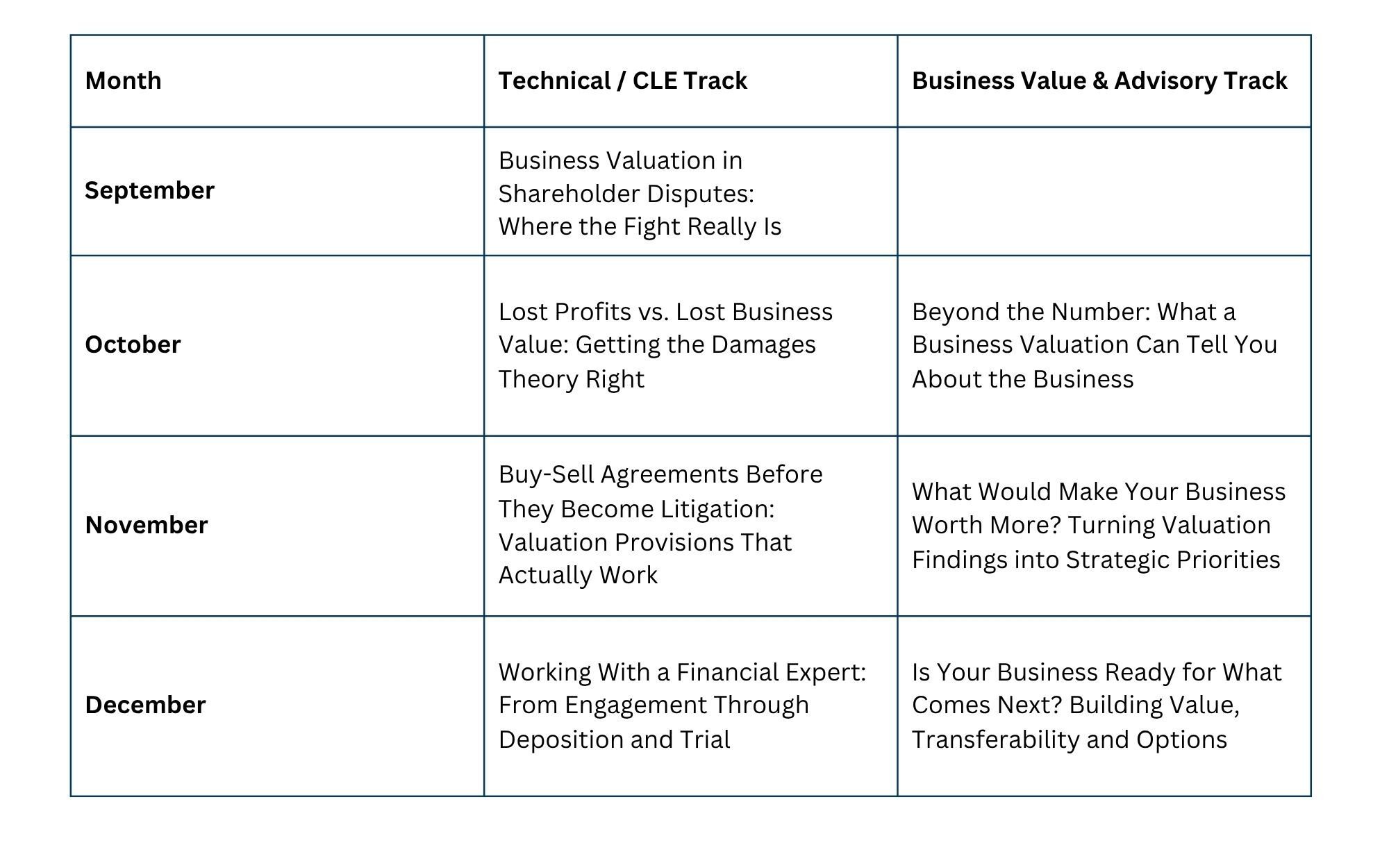 All webinars will be held at 11:00 a.m. Central Time.
For Attorneys: When the Number Matters
Our Technical/CLE Track will dig into situations where valuation and financial analysis can have a direct impact on a legal matter.
We’ll begin on September 22 with Business Valuation in Shareholder Disputes: Where the Fight Really Is.
Business valuation disputes rarely come down to arithmetic. The real differences often involve assumptions: the appropriate standard and level of value, normalization adjustments, control and marketability, future expectations, and the valuation date. Understanding where—and why—valuation conclusions diverge can help attorneys better evaluate both the financial issues and the expert opinions in a case.
On October 29, Lost Profits vs. Lost Business Value: Getting the Damages Theory Right will explore two concepts that are sometimes used interchangeably but shouldn’t be. We’ll look at how the appropriate damages theory is developed and the financial analysis underlying each approach. Our prior economic damages programming has addressed the distinction between lost profits and lost business value; this session will take that discussion further into how the theory fits the facts of the matter.
Then, on November 24, we’ll present Buy-Sell Agreements Before They Become Litigation: Valuation Provisions That Actually Work.
We’ve seen how outdated agreements, incomplete triggering events, and ambiguous valuation language can create problems precisely when owners need clarity most. This program will look at buy-sell provisions through a practical lens: what happens when the agreement actually has to be used?
Finally, on December 15, we’ll wrap up the Technical/CLE Track with Working With a Financial Expert: From Engagement Through Deposition and Trial.
We’ll take attorneys behind the scenes of the expert process—from defining the scope of the engagement and gathering the right information through expert reports, discovery, deposition, and trial. The goal is simple: help counsel understand how to work more effectively with financial experts and make better use of their expertise throughout a matter.
For Business Owners and Advisors: Using Valuation Differently
Our second track reflects something we see again and again in our valuation work.
The process of determining value often tells us just as much about the business as it does about the number.
Two businesses can generate identical EBITDA and still have very different values. One might rely heavily on a single customer, have high employee turnover, and operate near capacity. Another might have diversified customers, low employee turnover, contracts for future work, and room to grow. We’ve long used comparisons like these to demonstrate why EBITDA alone doesn’t determine value.
This fall, we’re going to focus more intentionally on what those differences can teach business owners.
We’ll begin the Business Value & Advisory Track on October 15 with Beyond the Number: What a Business Valuation Can Tell You About the Business.
Rather than focusing on valuation methodology, we’ll explore what the valuation process can reveal about the quality and durability of earnings, concentration, management depth, owner dependency, capacity, financial reporting, and other factors that affect risk and value.
On November 11, What Would Make Your Business Worth More? Turning Valuation Findings into Strategic Priorities moves from insight to action.
Not every weakness deserves equal attention—and not every growth initiative creates value. We’ll talk about identifying the factors that are helping or hurting value and using those findings to determine which strategic priorities could make the greatest difference. Our prior programming has identified recurring revenue, market position, and owner independence as potential value drivers, while concentration, lack of succession planning, and poor financial reporting can detract from value. This program asks the next question: What do you do about it?
Finally, on December 8, we’ll ask: Is Your Business Ready for What Comes Next? Building Value, Transferability and Options.
“What comes next” doesn’t necessarily mean selling the company.
It could mean an acquisition opportunity, an ownership transition, management succession, an unexpected offer—or simply an owner deciding that the business needs to depend less heavily on them.
One of the fundamental questions in valuation is whether a business is truly transferable or whether it is largely dependent on a particular individual and that person’s skills and relationships. A stronger, more transferable business doesn’t just have the potential to be worth more. It gives its owners more options.
From Valuation to Action
Valuation will always be at the core of what we do.
But we also believe its greatest value isn’t always the number at the end of the report.
Sometimes it’s the questions the process raises.
Where is value concentrated? Where is it vulnerable? What is creating risk? What would make the earnings more durable? How dependent is the business on its owner? And which changes could have the greatest impact on long-term value?
Those are valuation questions.
They’re also strategic questions.
And this fall, we’re looking forward to exploring both.
Registration information for each webinar will be available soon.